Checkpointing and Resumable Training Guide¤
| Metadata | Value |
|---|---|
| Level | Advanced |
| Runtime | ~3 min |
| Prerequisites | Pipeline Quickstart, Operators Tutorial |
| Format | Python + Jupyter |
| Memory | ~500 MB RAM |
Overview¤
Implement fault-tolerant training pipelines that can resume from
interruptions using the NNX-standard checkpoint pattern —
nnx.to_pure_dict for snapshotting state, orbax.checkpoint.StandardCheckpointer
for persistence, and nnx.replace_by_pure_dict + nnx.update for
restoration. The triple (pipeline, model, optimizer) is checkpointed
together so resumption restores data-cursor position, model weights,
and optimizer state from a single Orbax directory.
Learning Goals¤
- Snapshot an
nnx.Module's state withnnx.to_pure_dict. - Persist that snapshot with
orbax.checkpoint.StandardCheckpointer. - Restore the snapshot back into a freshly-constructed module with
nnx.replace_by_pure_dictfollowed bynnx.update. - Checkpoint a
(pipeline, model, optimizer)triple atomically so resumption preserves data position, model weights, and optimizer state simultaneously. - Verify deterministic resumption: a run that checkpoints at step
k, loads, and continues should match a never-interrupted run exactly.
Coming from PyTorch?¤
| PyTorch | Datarax |
|---|---|
torch.save({'model': model.state_dict(), 'optimizer': opt.state_dict()}) |
checkpointer.save(path, {'model': nnx.to_pure_dict(nnx.state(model)), ...}) |
model.load_state_dict(torch.load(path)['model']) |
nnx.replace_by_pure_dict(nnx.state(model), saved) then nnx.update(model, state) |
| DataLoader state not saved | Pipeline is itself an nnx.Module — same checkpoint API includes its state |
Key difference: Datarax Pipeline is an nnx.Module, so the
data-cursor position, sampler state, and stochastic-stage RNGs
checkpoint with the exact same three-call pattern as the model.
Coming from TensorFlow?¤
| TensorFlow | Datarax |
|---|---|
tf.train.Checkpoint(model=model, optimizer=opt) |
nnx.to_pure_dict(nnx.state(...)) per object |
ckpt_manager.save() |
StandardCheckpointer.save(path, snapshot_dict) |
ckpt.restore(...) |
StandardCheckpointer.restore(path, template) then nnx.update |
tf.train.CheckpointManager(max_to_keep=3) |
orbax.checkpoint.CheckpointManager(max_to_keep=3) |
Files¤
- Python Script:
examples/advanced/checkpointing/02_resumable_training_guide.py - Jupyter Notebook:
examples/advanced/checkpointing/02_resumable_training_guide.ipynb
Quick Start¤
Key Concepts¤
The Three-Call NNX Checkpoint Pattern¤
import orbax.checkpoint as ocp
from flax import nnx

# Save
checkpointer = ocp.StandardCheckpointer()
checkpointer.save(path, {
    "model": nnx.to_pure_dict(nnx.state(model)),
    "optimizer": nnx.to_pure_dict(nnx.state(optimizer)),
    "pipeline": nnx.to_pure_dict(nnx.state(pipeline)),
})
checkpointer.wait_until_finished()

# Restore — into freshly-constructed objects
template = {
    "model": nnx.to_pure_dict(nnx.state(model)),
    "optimizer": nnx.to_pure_dict(nnx.state(optimizer)),
    "pipeline": nnx.to_pure_dict(nnx.state(pipeline)),
}
saved = checkpointer.restore(path, template)

for module, pure in (
    (model, saved["model"]),
    (optimizer, saved["optimizer"]),
    (pipeline, saved["pipeline"]),
):
    state = nnx.state(module)
    nnx.replace_by_pure_dict(state, pure)
    nnx.update(module, state)
Why nnx.update?¤
nnx.state(module) returns a copy of the module's state. Calling
nnx.replace_by_pure_dict on that copy mutates the local object but
not the module. nnx.update(module, state) writes the updated state
back into the module — without it, the resume looks like a reset.
Three-Phase Verification¤
The example runs:
- Reference — train uninterrupted for
Nsteps; record loss curve. - Crash — re-train with the same seed but interrupt at step
k, writing a checkpoint just before. - Resume — construct fresh model/optimizer/pipeline, load the
step-
kcheckpoint, continue to stepN.
Both the loss curve and the final model parameters must match the reference exactly. The example asserts:
max_param_diff = max(
    jax.tree_util.tree_leaves(
        jax.tree.map(_max_abs_diff, ref_params, restored_params)
    )
)
assert max_param_diff < 1e-3
Pipeline State Captured¤
The Pipeline nnx.Module includes:
_position— current iteration index (advances bybatch_sizeper step).rngs— the Pipeline's ownnnx.Rngs, used to generate per-step keys.source— the data source as a child module (its index, RNGs, cached state are all part of the tree).- Each stage in
stages=[...]— including any stochastic operator'snnx.Rngs.
nnx.to_pure_dict(nnx.state(pipeline)) captures all of these in a
single call.
Results¤
Running the guide produces:
PHASE 1: reference run (60 steps, no checkpoints)
============================================================
Reference: 60 steps, final loss=1.0196

PHASE 2: train, checkpoint every 10, interrupt at step 30
============================================================
Crashed: 30 steps, final loss=1.5023
Available checkpoints: ['step_10', 'step_20', 'step_30']

PHASE 3: restore from step 30, train to step 60
============================================================
Resumed: end step=60, final loss=1.0196
Total resumed-curve length: 60 (expected 60)

Max |reference - resumed| over 60 steps: 0.0000e+00
Max |reference - resumed| over model params: 0.0000e+00
Determinism check passed: model parameters round-trip through Orbax.
Visualization¤
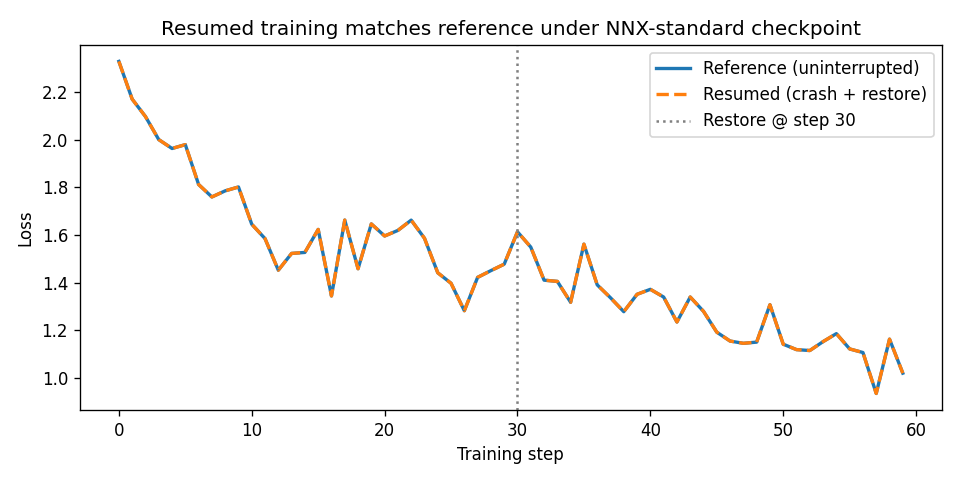
The reference curve (uninterrupted) and the resumed curve (crash + restore) coincide exactly — every step before and after the checkpoint produces the same loss in both runs.
Best Practices¤
Snapshot Everything That Mutates¤
If you forget to checkpoint a piece of state that the training step
mutates, the resumed run will diverge silently. The state-equality
assertion in this example surfaces such bugs immediately. The
canonical "everything that mutates" set is (model, optimizer,
pipeline) — Pipeline being an nnx.Module is what makes the data
position checkpointable on equal footing with model weights.
Use CheckpointManager for Production¤
For periodic-cleanup, async writes, and atomic step-N labeling, wrap
the StandardCheckpointer calls in
orbax.checkpoint.CheckpointManager:
manager = ocp.CheckpointManager(
    directory=ckpt_dir,
    options=ocp.CheckpointManagerOptions(max_to_keep=3),
)
manager.save(step, snapshot)
manager.wait_until_finished()
Restore Templates Must Match¤
StandardCheckpointer.restore(path, template) requires the template
to have the same PyTree structure as the saved data. Build the
template by snapshotting the freshly-constructed modules — that
guarantees the structures match.
Common Pitfalls¤
| Pitfall | Symptom | Fix |
|---|---|---|
Forgot nnx.update after replace_by_pure_dict |
Resumed run produces same losses as a fresh run, ignoring restore | Add nnx.update(module, state) |
| Missing pipeline in snapshot | Resumed run sees the same data again from step 0 | Include pipeline in the snapshot dict |
Saving nnx.Module directly to Orbax |
TypeError: cannot serialize <Module> |
Always wrap in nnx.to_pure_dict(nnx.state(...)) |
| Template mismatch on restore | Orbax raises a structure-mismatch error | Build template by snapshotting freshly-constructed objects |
Next Steps¤
- Checkpoint Quick Reference — single-pipeline checkpoint basics
- DAG Construction Guide — branching pipelines (the checkpoint pattern is identical)
- Sharding Guide — checkpointing under multi-device sharding
API Reference¤
Pipeline— Pipeline class as annnx.Module- Orbax Checkpoint Documentation —
StandardCheckpointer,CheckpointManager - Flax NNX Checkpointing Guide —
nnx.to_pure_dict,nnx.replace_by_pure_dict,nnx.update