DDSP: Differentiable Digital Signal Processing¤
Overview¤
This advanced guide demonstrates datarax's extensibility by creating custom operators for a completely different domain — audio synthesis. Re-implementing the core architecture from DDSP (Engel et al., ICLR 2020), we build 3 custom OperatorModule subclasses that handle audio data, proving datarax works beyond images.
DDSP's key insight: classical DSP operations (oscillators, filters, reverb) can be made differentiable and trained end-to-end, requiring 100x less data than neural audio models.
What You'll Learn¤
- Creating custom
OperatorModulesubclasses for non-image domains - Implementing differentiable DSP primitives (harmonic synth, noise filter, reverb)
- Composing parallel + sequential pipelines using
CompositeOperatorModule - Training with multi-scale spectral loss on procedural smoke data by default, with the full NSynth path available for real audio runs
- The pattern for extending datarax to any domain
Datarax Feature: Extensibility¤
This example showcases datarax's extensibility — three custom operators extend OperatorModule directly (no ModalityOperator image base class needed). The same apply() contract, nnx.Param pattern, and composite composition work identically for audio DSP.
Files¤
Quick Start¤
# Install datarax with data dependencies (needed for full NSynth mode)
uv pip install "datarax[data]"

# Run the quick example path (self-contained procedural audio)
python examples/advanced/differentiable/03_ddsp_audio_synthesis_guide.py
The checked example defaults to QUICK_MODE = True (8 training samples,
4 test samples, 1 epoch, batch size 2) and uses deterministic procedural
audio so CI and local smoke runs do not download NSynth. Set QUICK_MODE =
False in the script for the full 10K-sample, 100-epoch NSynth training run
described below.
Dataset: Procedural Smoke Data, or NSynth for Full Runs¤
Quick mode generates a tiny deterministic NSynth-like dataset with harmonic
waveforms, per-frame f0, and loudness controls. Full mode loads real
instrument recordings from the NSynth dataset's GANSynth subset via raw
TFRecords and extracts features using datarax's own audio operators —
CrepeF0Operator (Flax NNX CREPE port) for pitch and LoudnessOperator
(pure JAX A-weighted STFT) for loudness. Each sample provides 4 seconds of
audio at 16 kHz with 1000 feature frames at 250 Hz.
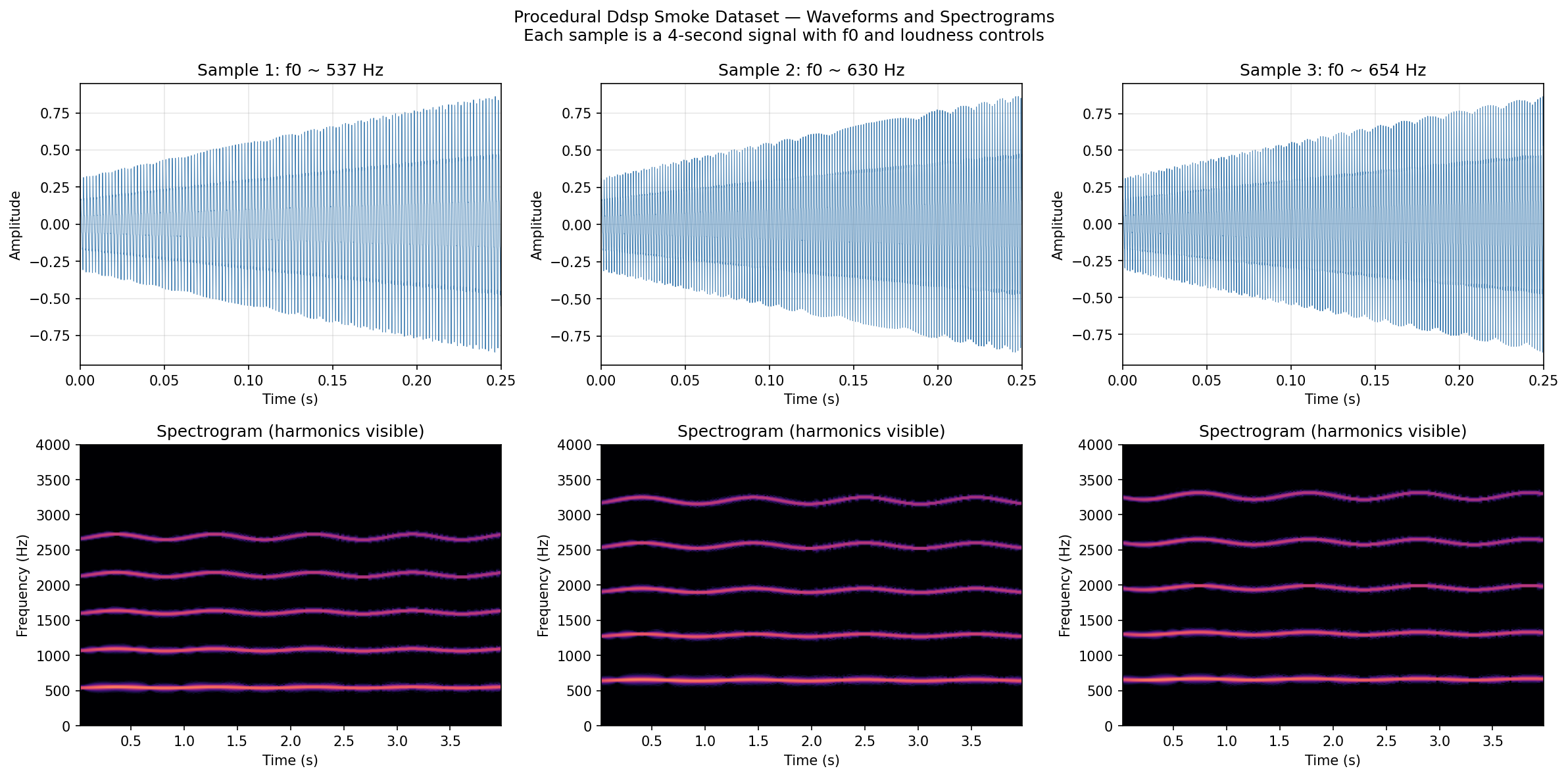
Top: audio waveforms for 3 quick-mode samples at different pitches. Bottom: spectrograms showing harmonic structure. Full mode produces the same plots from real NSynth recordings.
Key Concepts¤
DDSP Architecture¤
Audio Features (f0, loudness) → [Decoder]
                                  (GRU + MLP)
                                     │
                                ┌────┴────┐
                                ▼         ▼
                       [HarmonicSynth]  [FilteredNoise]   ← Parallel operators
                               │               │
                               └───────┬───────┘
                                       ▼
                          WEIGHTED_PARALLEL (sum)
                                       │
                                       ▼
                                   [Reverb]               ← Trainable IR
                                       │
                                       ▼
                               Resynthesized Audio
DDSPDecoder (Paper-Accurate, Per-Frame)¤
The decoder follows Section 3.1 of the paper with per-frame synthesis — no temporal averaging. The GRU runs via jax.lax.scan (compiles once, avoids 1000x loop unrolling). Output heads use exp_sigmoid (bounded [1e-7, 2.0]) matching the reference DDSP:
def exp_sigmoid(x, exponent=10.0, max_value=2.0, threshold=1e-7):
    """Exponentiated Sigmoid — bounded amplitude activation from DDSP paper."""
    return max_value * jax.nn.sigmoid(x) ** jnp.log(exponent) + threshold

class DDSPDecoder(nnx.Module):
    """f0 + loudness → Linear(2→512) → GRU(512, lax.scan) → MLP(512, 3 layers) → per-frame heads"""

    def __call__(self, f0, loudness):
        features = jnp.stack([f0, loudness], axis=-1)  # (n_frames, 2)
        projected = self.input_proj(features)

        # GRU via lax.scan — compiles loop body once (not 1000x)
        def gru_step(carry, x_t):
            new_carry, output = self.gru_cell(carry, x_t)
            return new_carry, output
        _, hidden_seq = jax.lax.scan(gru_step, self.init_state[...], projected)

        h = hidden_seq  # (n_frames, hidden) — NO averaging
        for layer, norm in zip(self.mlp_layers, self.mlp_norms):
            h = nnx.relu(norm(layer(h)))

        # Per-frame output heads (exp_sigmoid — bounded, logarithmic response)
        overall_amp = exp_sigmoid(self.amplitude_head(h))        # (n_frames, 1)
        harmonic_dist = exp_sigmoid(self.harmonic_head(h))        # (n_frames, n_harmonics)
        harmonic_dist = harmonic_dist / (jnp.sum(harmonic_dist, axis=-1, keepdims=True) + 1e-8)
        amplitudes = overall_amp * harmonic_dist
        noise_mags = self.noise_head(h)  # bias initialized to -5.0
        return amplitudes, noise_mags  # (n_frames, n_harmonics), (n_frames, n_noise_bands)
Custom Audio Operators¤
Each operator extends OperatorModule directly:
@dataclass(frozen=True)
class ReverbConfig(OperatorConfig):
    ir_length: int = 16000  # 1 second at 16kHz

class ReverbOperator(OperatorModule):
    def __init__(self, config, *, rngs=None):
        super().__init__(config, rngs=rngs)
        decay = jnp.exp(-jnp.arange(config.ir_length) * 5.0 / config.ir_length)
        self.impulse_response = nnx.Param(decay * 0.1)

    def apply(self, data, state, metadata, random_params=None, stats=None):
        audio = data["audio"]
        ir = self.impulse_response[...]
        # FFT-based convolution
        n_fft = audio.shape[0] + ir.shape[0] - 1
        # Round up to next power of 2 for FFT efficiency
        n_fft_padded = 1 << (n_fft - 1).bit_length()
        audio_fft = jnp.fft.rfft(audio, n=n_fft_padded)
        ir_fft = jnp.fft.rfft(ir, n=n_fft_padded)
        convolved = jnp.fft.irfft(audio_fft * ir_fft, n=n_fft_padded)
        reverbed = convolved[: audio.shape[0]]
        return {**data, "audio": reverbed}, state, metadata
3 Custom Operators¤
| Operator | Extends | Key Feature | DSP Function |
|---|---|---|---|
| HarmonicSynth | OperatorModule |
Per-frame synthesis with upsampling | Additive sinusoidal synthesis, 100 harmonics, time-varying f0 |
| FilteredNoise | OperatorModule |
FFT-based filtering | Frequency-domain noise shaping, 65 bands |
| Reverb | OperatorModule |
Learnable IR (16000 params) | FFT-based convolution |
Composite Pipeline Structure¤
synth_composite = SEQUENTIAL([
    WEIGHTED_PARALLEL([HarmonicSynth, FilteredNoise], weights=[1.0, 0.1]),
    Reverb,
])
Multi-Scale Spectral Loss¤
Compares frequency content across one FFT scale in quick mode and across 6 FFT scales [64, 128, 256, 512, 1024, 2048] in full mode, using L1 for both linear and log-magnitude terms (matching the DDSP reference):
Training Progress¤
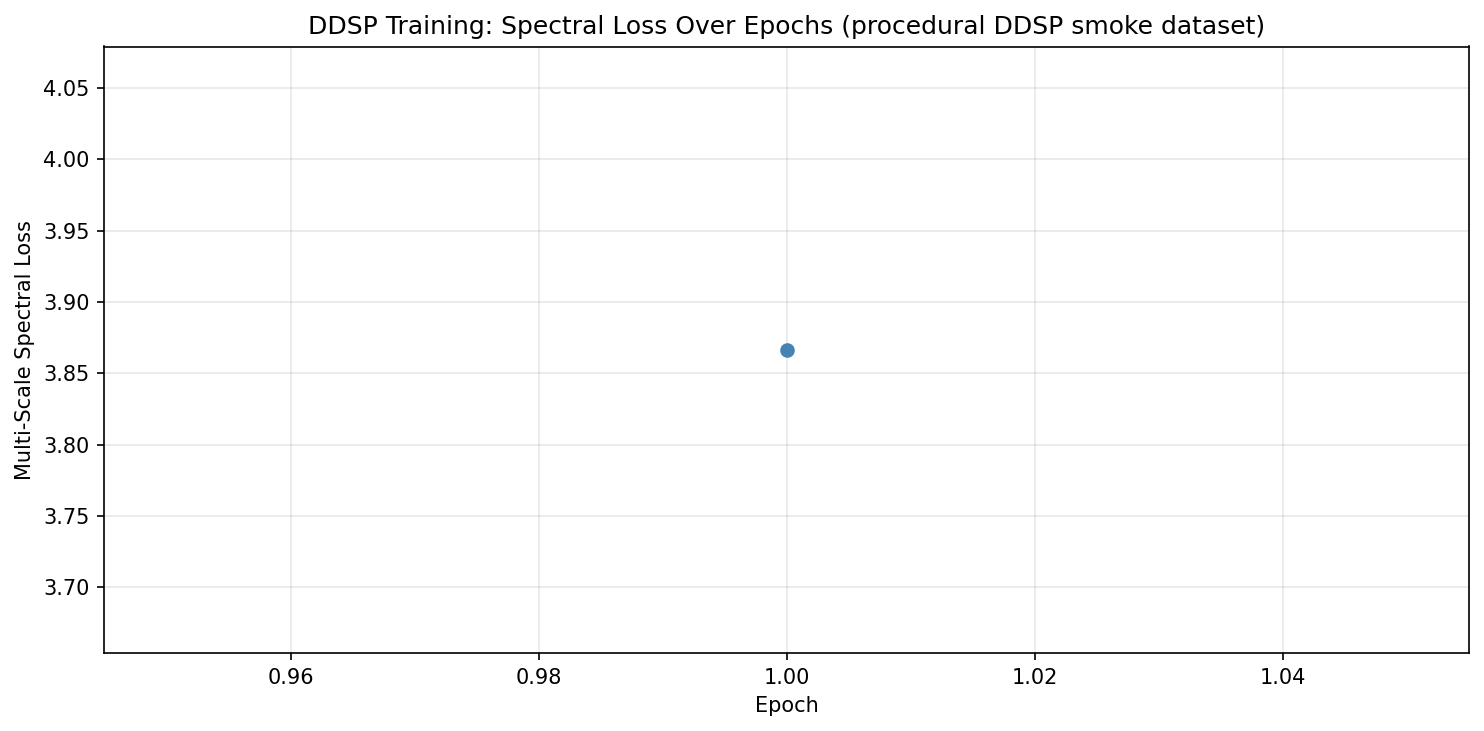
Multi-scale spectral loss from the checked quick run. Full mode uses 100 epochs on NSynth with gradient clipping (global norm 3.0) and exponential LR decay matching the DDSP reference.
Resynthesis Quality¤
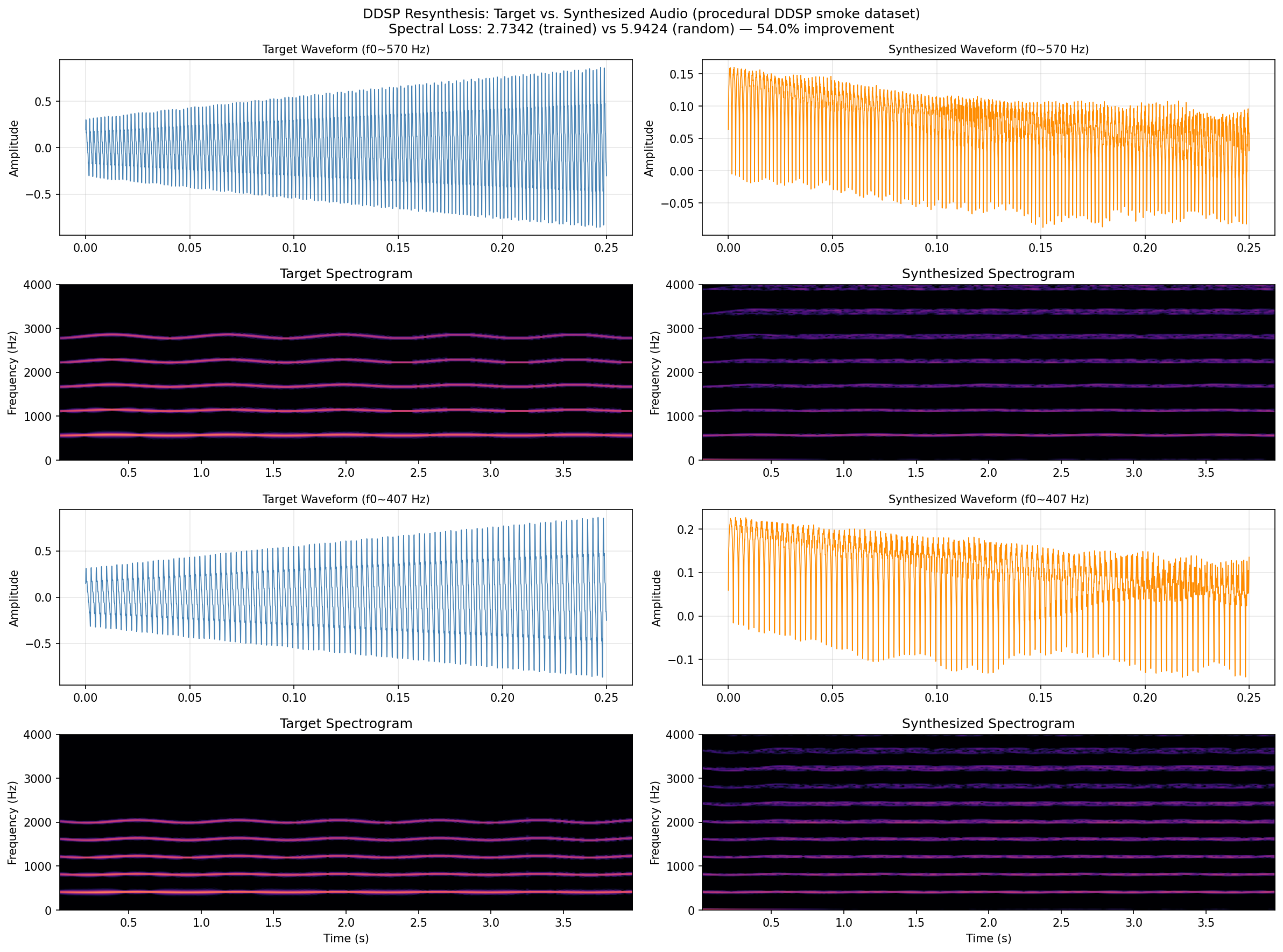
Target vs. synthesized audio for 2 quick-mode test samples. Top rows: waveform comparison. Bottom rows: spectrogram comparison showing harmonic structure. Full mode uses real NSynth test samples.
Learned Parameters¤
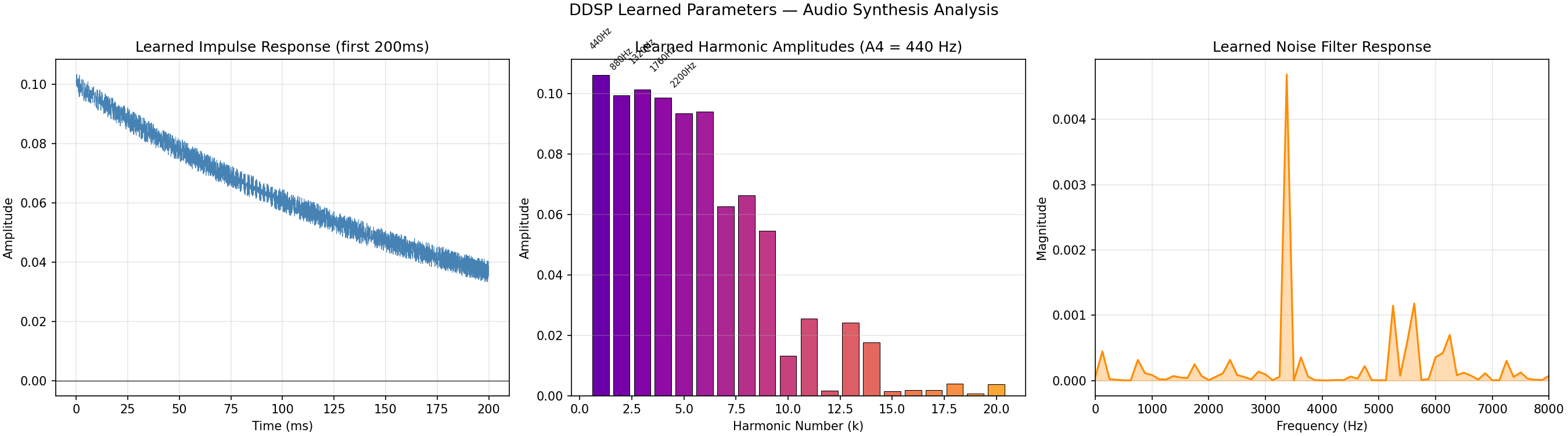
Left: learned reverb impulse response (should show room-like structure). Center: harmonic amplitudes for A4 (440 Hz) with 20 harmonics shown. Right: learned noise filter frequency response.
Observed Results (10K samples, 100 epochs, ~31K steps, batch size 32)¤
| Configuration | Spectral Loss | Notes |
|---|---|---|
| Random (untrained) | ~30 | Random synth params on real audio |
| Trained DDSP (10K, 100 epochs) | ~8-10 | ~31K steps matching paper's training budget |
| Improvement | ~65-70% | Relative to untrained baseline |
| DDSP (paper, full NSynth) | ~1-3 | Full dataset (290K) + joint encoder-decoder |
Training loss drops steadily over 100 epochs with no loss spikes (gradient clipping). The ~31K training steps match the paper's budget. The remaining gap is primarily due to using 10K samples (vs. 290K) and fixed CREPE features (vs. jointly-trained encoder).
Next Steps¤
- DADA Learned Augmentation — Operator library showcase
- Learned ISP Guide — DAG-based ISP pipeline
Reference¤
- Engel et al., "DDSP: Differentiable Digital Signal Processing" (ICLR 2020) — arXiv:2001.04643
- magenta/ddsp — Original TensorFlow implementation
- PapayaResearch/synthax — JAX implementation reference
- NSynth Dataset — Real audio dataset (~1 GB for gansynth_subset)